At What Point Did You Just Accept That Your Gut Was Never Going to Heal?


You gave up coffee. That was probably the first thing.
Then alcohol. Then anything spicy. Then citrus, tomatoes, chocolate, anything fried. Then dairy, just to be safe. Then gluten, just in case. You've been eating the same five things for months — oatmeal, rice, plain chicken, bananas, maybe steamed vegetables on a good day.
You take your supplements on schedule. Maybe DGL before meals. Probiotics in the morning. Slippery elm. Zinc. L-glutamine. Aloe. You've spent more at the health food store this year than most people spend in a decade.
You don't cheat. You don't slip. You're doing every single thing they told you to do.
And your gut still doesn't feel right.
The bloating after meals you swore were "safe." The dull ache that sits in the background no matter what. The mornings you wake up already uncomfortable, before you've eaten a single thing. The exhaustion you can't explain to anyone because they don't get how much energy it takes to manage your stomach all day.
You've started to wonder if this is just how it's going to be from now on.
You've started to wonder if your gut is just... broken.
I've spent the last 27 years studying exactly this. Why some people respond to dietary changes and supplementation. And why others follow the exact same protocols and stay stuck for years.
And here's what I can tell you — calmly, with no agenda:
If you've been doing everything right and your gut still feels off, the problem isn't your discipline.
The Part of Gut Recovery Nobody Explains
Most people think of their gut as a passive thing. A tube. Food goes in, gets processed, comes out. Something hurts the tube, you protect it.
That's not how it actually works.
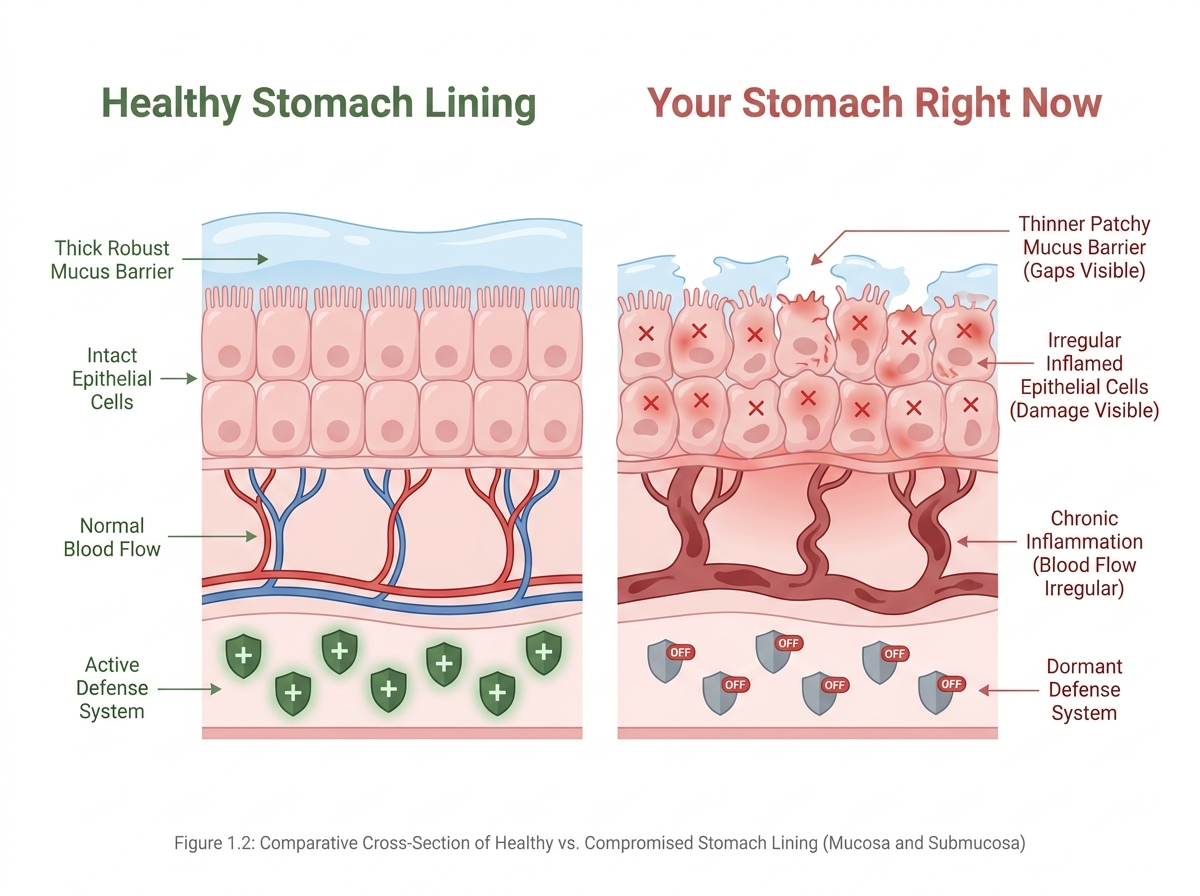
Your gut lining is one of the most active systems in your entire body. Every single day, healthy gut tissue is doing three things at the same time:
It's producing a thick layer of mucus that protects the lining from acid and bacteria.
It's generating its own internal antioxidants — compounds that neutralize damage before it spreads.
And it's running a constant repair cycle, replacing damaged cells faster than they can wear out.
When this system is working, your gut is incredibly resilient. You can have a stressful week. You can eat something rich. You can even have a meal that doesn't agree with you — and your gut takes the hit, repairs itself, and you don't even notice.
But here's what happens when your gut takes ongoing damage.
Whether it started from a bug you picked up years ago. From years of stress. From taking too many painkillers. From processed foods. From a bacteria called H. pylori that millions of people carry without ever being diagnosed.
The damage doesn't just hurt the lining.
It disrupts the system that's supposed to repair it.
The mucus layer thins. The cells that produce it slow down. And — this is the part nobody tells you — the internal pathway responsible for telling your gut to defend and repair itself goes quiet.
Not destroyed. Not gone.
Your gut's defense system didn't break. It went dormant.
And that's why you can eat perfectly, avoid every trigger, take every supplement on your shelf — and still feel exactly the same way you did six months ago.
Because removing irritants is not the same thing as turning the repair system back on.
Think of it like this.
Imagine the smoke alarm system in your house went offline during a storm. You could remove every candle. Unplug every appliance. Never cook again. You'd reduce the risk of a fire — sure.
But the alarm system would still be off. You'd be living in a house with no early warning. No automatic response. No protection if something small went wrong.
That's your gut right now. You've removed the threats. You've done everything they told you to do.
But the system that's supposed to protect and repair the lining? It's still sitting there, dormant, waiting for a signal to turn back on.
And nothing in your current routine is sending that signal.
Why Everything You've Tried Hasn't Worked
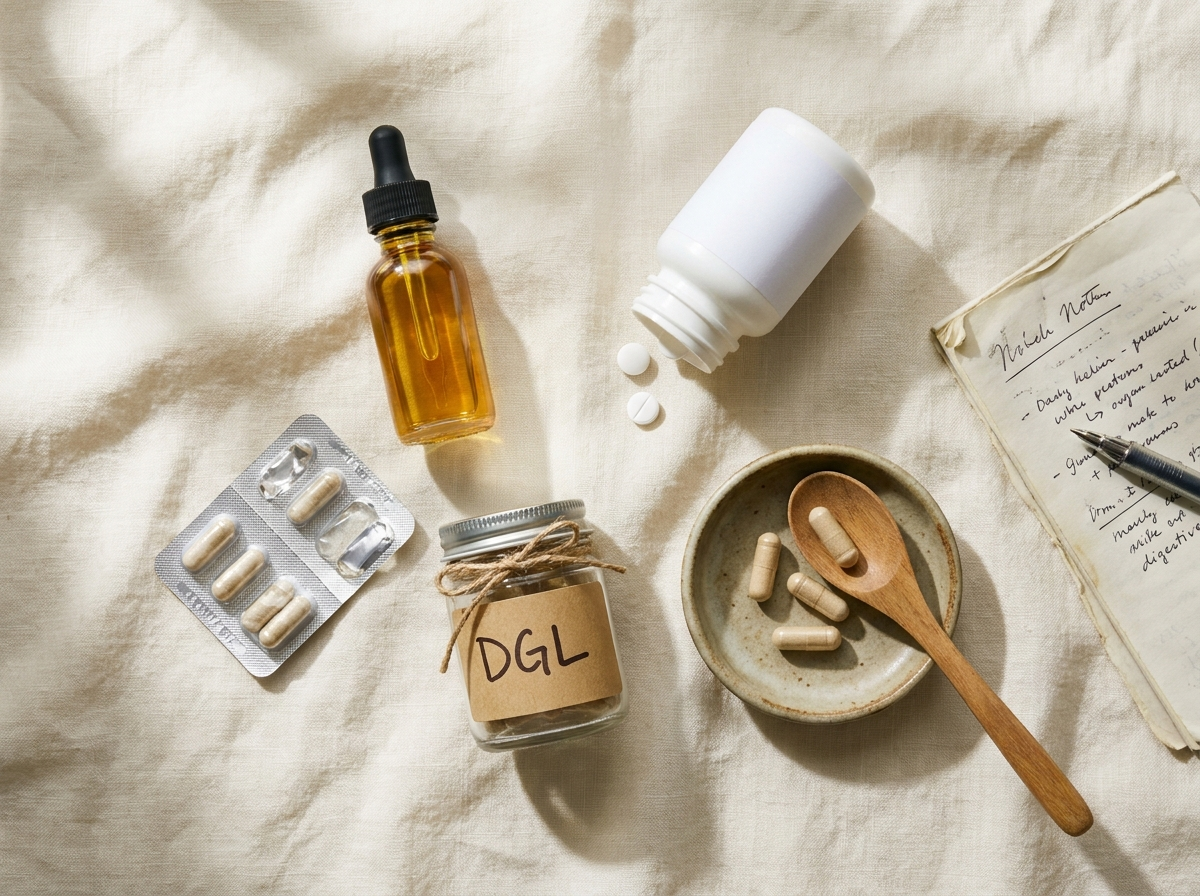
If you're like most people who've been managing gut issues for a while, your medicine cabinet tells a story. You've probably been through some version of this:
Acid reducers and PPIs. They helped at first. Maybe a lot at first. But they reduce acid — they don't repair the lining the acid was hurting. So the relief either faded, or stopping them brought everything back twice as bad. You ended up managing a symptom without ever fixing what was underneath.
Slippery elm. DGL. Aloe vera. The soothing supplements. They coat the surface. They calm things down for a few hours. And that matters. But they can't tell your gut cells to start producing their own protective compounds again. They're like spreading lotion on a sunburn — it feels better, but it doesn't change what's happening underneath.
Strict elimination diets. And yes, removing your trigger foods is essential. But removing triggers only stops new damage. It doesn't repair existing damage. It doesn't restart the system that keeps your lining strong. You can eat perfectly for a year and your gut's defense system can still be sitting there dormant — because nothing has told it to wake up.
Probiotics, L-glutamine, mastic gum, zinc carnosine. These all help in different ways. Some support gut bacteria. Some give your body building blocks for tissue repair. But none of them reach the specific pathway that signals your gut cells to actually start producing the protective compounds they're supposed to make on their own.
Here's the pattern.
Everything you've tried has either soothed the surface, reduced the acid, removed the triggers, or supported gut health in general.
That's not a criticism of those approaches. Most are genuinely useful as part of recovery. But they're working on the outer layers of the problem.
The reason you're still stuck is because the deeper problem — the dormant repair pathway inside your gut cells — has never received the signal it needs to turn back on.
And until pretty recently, almost nothing on the market could send that signal.
What We Found at Johns Hopkins
In the early 1990s, our research team at Johns Hopkins started studying a compound found in cruciferous vegetables — broccoli sprouts in particular, where it shows up in concentrations far higher than normal broccoli.
The compound is called sulforaphane.
We weren't initially looking at gut health. We were studying how it protected cells from environmental damage. But over the next decade, our team and others around the world started noticing something unusual happening when sulforaphane reached the stomach.
It wasn't just soothing the lining. It wasn't just adding antioxidants from the outside. It was doing something nothing else seemed to do.
It was activating a specific pathway inside the gut cells themselves.
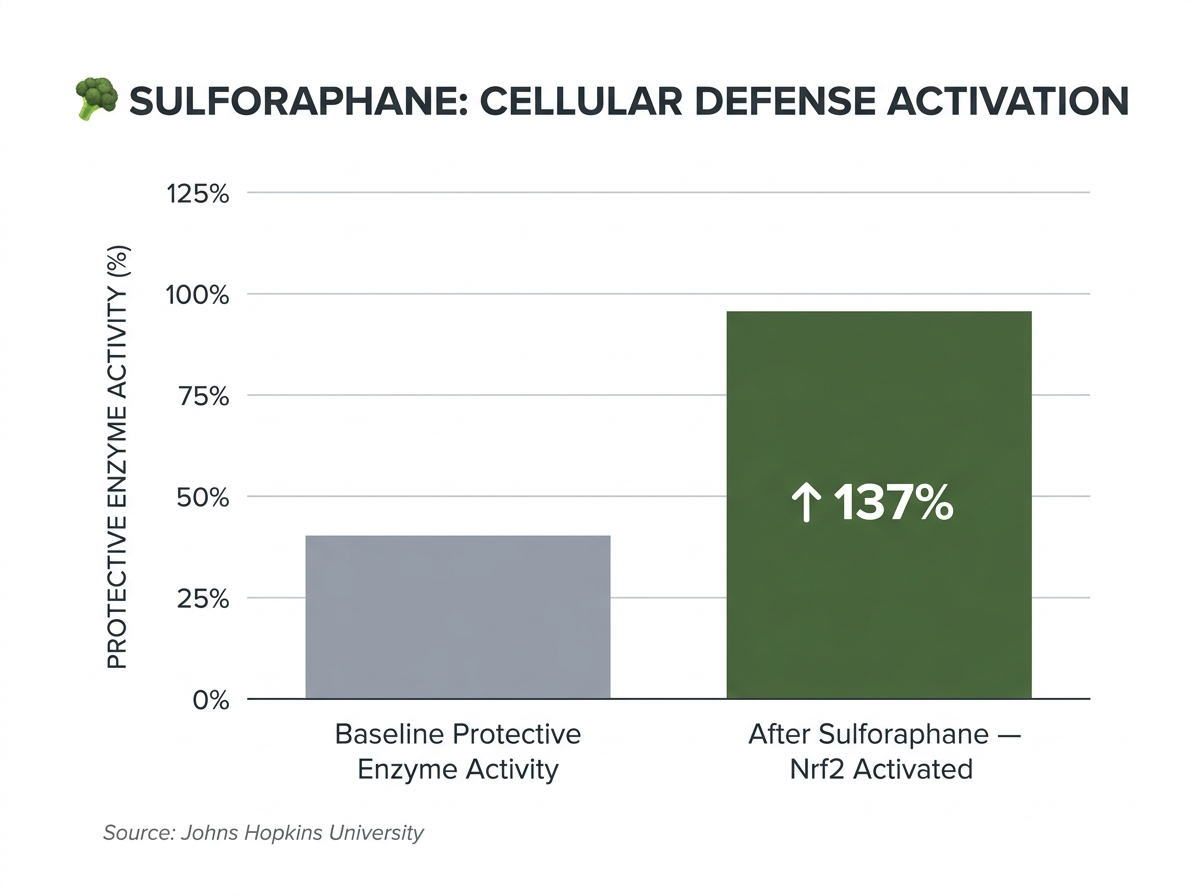
This pathway is called Nrf2 — and the easiest way to think about it is as the master switch for your gut's internal protection system.
When Nrf2 is switched on, your gut cells do four things they can't do when it's switched off:
They produce their own internal antioxidants — including the most powerful one your body makes, which directly protects the gut lining from inflammation and damage.
They generate enzymes that break down the inflammatory compounds keeping your gut sensitive and reactive to food.
They support the cells that produce your protective mucus layer — the actual physical shield between your stomach acid and your gut tissue.
And they shift your gut from a state of chronic damage response into a state of active repair.
When Nrf2 is dormant — which it almost always is after months or years of gut issues — none of this is happening properly. Your gut is stuck in a cycle of damage without enough repair to keep up.
Which is exactly what "doing everything right and still feeling stuck" feels like from the inside.
Sulforaphane reactivates that cycle.
In an 8-week clinical trial, people taking concentrated broccoli sprout extract showed:
- Significant reduction in gut inflammation markers
- Decreased oxidative stress in stomach tissue
- Improved gut lining integrity
- Measurable improvement in the overall gastric environment
But here's the part that matters most for someone in your position.
This is what makes sulforaphane different from everything else you've tried.
PPIs reduce acid. DGL soothes the surface. Elimination diets remove triggers. Probiotics support flora.
Sulforaphane goes to the cellular level and reactivates the defense system that long-term gut issues shut down in the first place.
It isn't adding something from the outside.
Why You Probably Haven't Heard About This
Three reasons.
One — there's no pharmaceutical money in broccoli.
Sulforaphane is a natural compound. No company can patent it, which means no company has a billion-dollar reason to fund massive awareness campaigns or get doctors to prescribe it. The research exists — in respected journals, from respected institutions — but it's not being pushed through the marketing channels that get attention. It just quietly sits in the literature, helping the people who happen to find it.
Two — you can't realistically get enough from food alone.
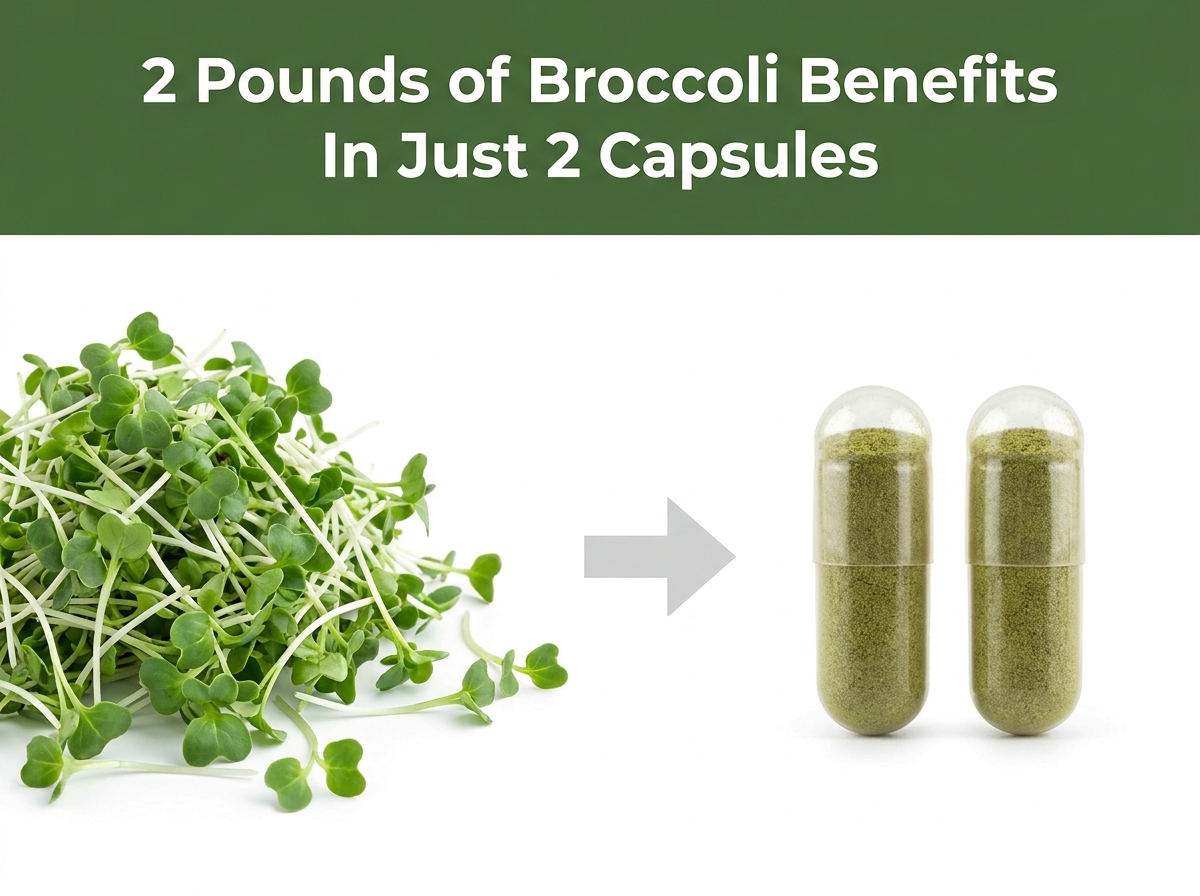
The clinical trials used concentrated broccoli sprout extract — the equivalent of eating roughly two pounds of fresh raw broccoli sprouts every single day. For weeks. Nobody is doing that. And cooked broccoli doesn't work the same way — heat destroys the enzyme required to convert the precursor compound into active sulforaphane. Whole food alone won't get you there.
Three — most "broccoli extract" supplements don't actually work.
This is the one that frustrates me most as a researcher.
Sulforaphane is unstable. It degrades quickly. But here's the bigger problem — sulforaphane doesn't actually exist in the plant directly. What exists is a precursor called glucoraphanin. To turn into active sulforaphane in your body, glucoraphanin has to interact with a specific enzyme called myrosinase.
Most broccoli supplements on the market contain glucoraphanin alone. No enzyme. No conversion. Which means the active compound never actually forms. You're swallowing an inactive plant powder and hoping your already-compromised gut can do the conversion on its own — and most of the time, it can't.
This is why most "broccoli extract" capsules from Amazon don't work. The dose is too low. Or the enzyme is missing. Or the compound degraded before the bottle ever reached the shelf.
It's also why people who try eating fresh sprouts get inconsistent results. Even when the science is real, the delivery almost never matches what the research used.
What It Takes to Actually Reactivate Your Gut's Repair System
Knowing sulforaphane works is one thing. Getting it to actually work inside your body is another. Here's what separates real recovery from more of the same:
The compound has to actually form inside your body.
This eliminates almost every product on the market. You need a formula that contains both the precursor (glucoraphanin) AND the enzyme (myrosinase) needed to convert it. Without both, you're paying for plant powder that does nothing.
You need to take it for at least 6–8 weeks.
Your gut has been stuck for months or years. The repair pathway didn't go dormant overnight, and it won't fully wake up overnight either. Most people notice the first subtle shifts in the first 2–3 weeks. The real change — where your gut starts to genuinely feel different — usually takes 6–8 weeks of daily, consistent use. This is rebuilding, not patching.
You keep doing what's already working.
Sulforaphane reactivates the repair system. But it doesn't replace common sense. Keep avoiding the foods that obviously trigger you. Keep managing stress. Keep getting reasonable sleep. The difference is that now, all those efforts finally have something solid to build on.
This isn't about sulforaphane being a miracle. It's about sulforaphane being the missing piece that lets everything else you're doing finally add up.
What I Found When I Looked at What Was Available
This is the problem I kept running into.
The science was strong. The mechanism was clear. The clinical results were real. But when I looked at what was actually on shelves — what someone could buy and take every single day — almost nothing matched the research.
Most products had glucoraphanin without the activating enzyme. A few had pre-formed sulforaphane that had already degraded by the time someone opened the bottle. A handful got the ingredients right but dosed them so low they'd never produce the cellular response the studies actually measured.
Then I came across Amara Organics' Broccoli Sprout Extract.
For the first time, the label matched the science.

Here's what's actually in it — and why each piece is there:
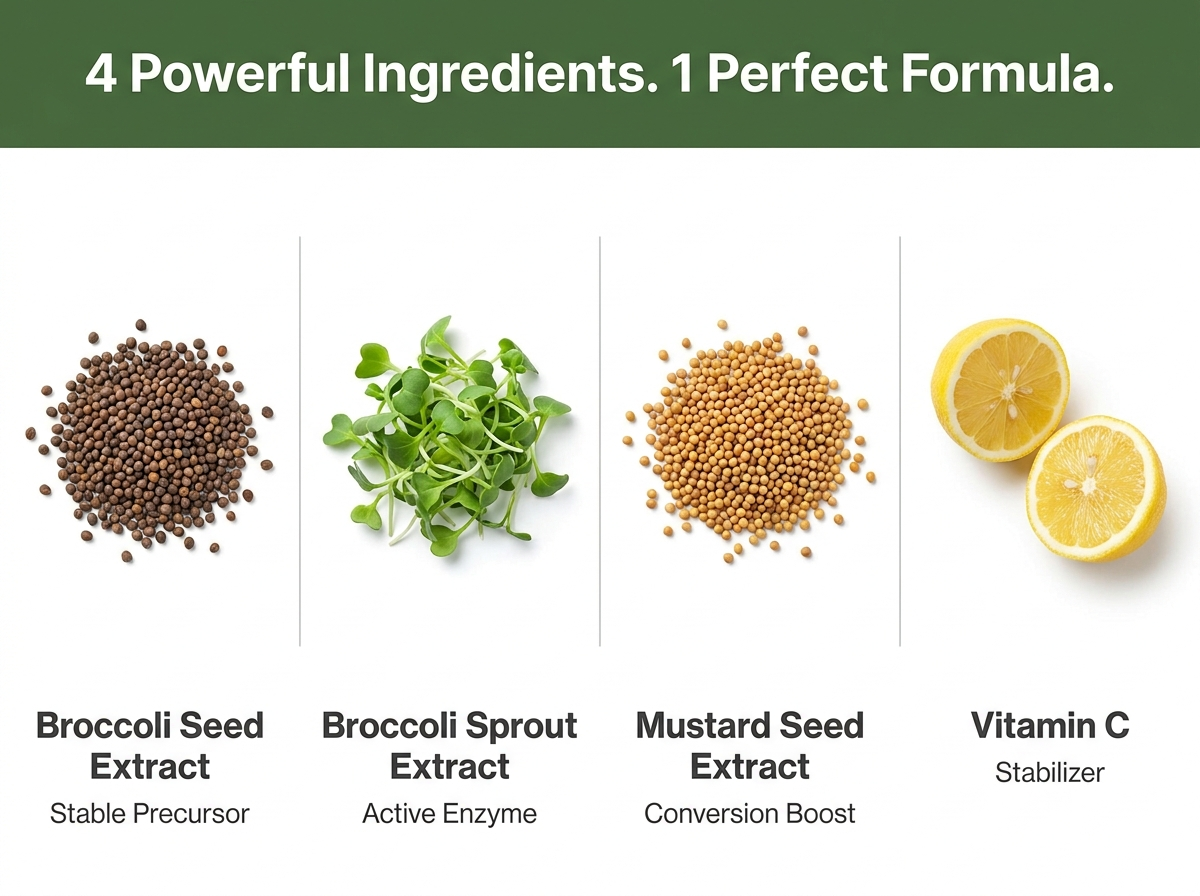
Broccoli Seed Extract (standardized to 13% glucoraphanin) — the stable precursor that becomes active sulforaphane in your gut. Concentrated to deliver the clinical-level dose researchers actually used. This is the fuel.
Broccoli Sprout Extract with active myrosinase — the spark. This is the live enzyme that converts glucoraphanin into bioavailable sulforaphane after you swallow it. Most formulas skip this entirely. Without it, the conversion never happens and the compound passes through you unused.
Mustard Seed Extract — a backup source of natural myrosinase that ensures conversion still happens even if some of the primary enzyme gets degraded by stomach acid. Researchers found this dramatically improves how much sulforaphane your body actually absorbs. It's a redundancy layer — and in a formula meant for people with already-compromised gut function, that redundancy matters.
Vitamin C — stabilizes sulforaphane during the conversion window and supports gut tissue integrity. Not a marketing add-on. A functional ingredient with a specific reason to be there.
Four ingredients. Each one has a job. Nothing extra.
No proprietary blends hiding weak doses. No 30-ingredient "gut health complex" where you can't tell what's actually working. No fillers, binders, or unnecessary botanicals that could irritate a stomach that's already sensitive.
Manufactured in an FDA-registered, GMP-certified facility. Third-party tested for heavy metals and potency. Non-GMO. Vegan. Every batch tested before it ships.
This is the formulation the research has been pointing at for years.
What Happens When Your Gut's Defense System Comes Back Online
Based on conversations with people who've gone through this process:
You probably won't feel much yet. That's normal. Cellular pathway activation is not the same as taking an antacid. What's happening underneath is that your repair pathway is starting to switch back on. The rebuilding has begun, but it hasn't reached the surface yet.
"Something feels different." "I realized I went a whole afternoon without thinking about my stomach." "I ate something that normally bothers me and... nothing happened." The constant background discomfort starts to ease. The food anxiety begins to loosen — not because you talked yourself into relaxing, but because your gut is actually giving you fewer reasons to worry.
Foods you've been avoiding for months become tolerable again. The burning is either gone or dramatically reduced. Your energy comes back — because a gut that's been chronically inflamed has been quietly draining you in ways you didn't realize. Sleep gets better. Brain fog clears.
People often report that their gut feels better than it did even before things first went wrong. Not just managed. Not just less bad. Actually resilient. They eat at restaurants. They travel without packing safe foods. They have an indulgent meal without paying for it for three days.
Not everyone's timeline is identical. If you've been dealing with severe gut issues for years, it may take longer.
But the consistent pattern is this: when people reactivate their gut's defense and repair system instead of just managing symptoms from the outside, they get to a place they'd long stopped believing was possible.
What People Are Saying
The One Thing I Wish More People Understood
I spent the first decade of my career thinking the answer to chronic gut problems was better acid control, smarter supplementation, and stricter dietary protocols.
I was trying to fix the problem from the outside.
What changed everything for me was understanding this:
It just needs the signal to start.
Chronic gut issues don't just damage tissue. They suppress the very pathway your gut relies on to protect and repair that tissue. And almost everything most people try — PPIs, soothing supplements, elimination diets, probiotics — works on the surface without ever reaching that deeper system.
Sulforaphane reaches it.
That's the difference between managing symptoms for years and actually giving your gut what it needs to rebuild.
Not a stronger antacid. Not a better supplement stack. Not a more restrictive diet.
A signal.
The signal that tells your gut cells to start defending again. Start repairing again. Start producing the protective compounds that keep the lining resilient.
That's what sulforaphane does. And that's what makes it different from everything else in your cabinet.
What Happens Next
If any of this resonates with you — if you're someone who's been doing everything right but still doesn't feel healed — there are essentially two paths from here.
Stay on the supplements. Maintain the restricted diet. Hope that time alone will eventually be enough. For some people, it eventually is — your gut does have the ability to slowly regenerate. But without ever reactivating the defense pathway, that process can take years. And for many people, full recovery never quite arrives. The discomfort fades, but never fully disappears. The food anxiety loosens, but never fully goes away.
Reactivate your gut's natural defense and repair system. Give your cells the signal they need to start producing protective compounds, rebuilding the mucus barrier, and actually repairing existing damage — not just preventing new damage. The research has been there for over 30 years. The mechanism is well-established. The clinical results back it up.
The only real question is whether you're going to keep managing from the outside, or finally give your gut what it needs to heal from the inside.
Your gut hasn't given up on you.
It's been waiting for the signal this entire time.
It just needs the right one.

- Free shipping
- 30-day money-back guarantee
- Bundle pricing · Save up to 60%
- FDA-registered, GMP-certified facility
- Third-party tested for purity